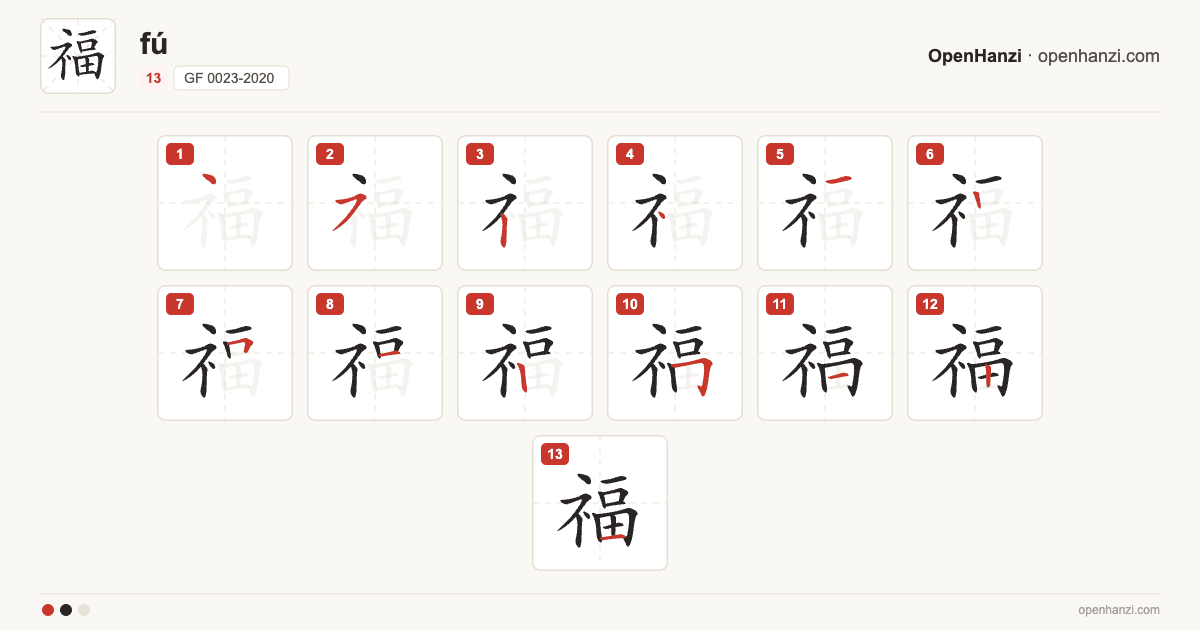
福 (Pinyin: fú, Radical: 礻, Structure: Left-right structure) has 13 strokes. According to national standard GF 0023-2020, the official stroke order sequence is: 1. Dot (diǎn, 点) → 2. Horizontal Slash (héng piě, 横撇) → 3. Vertical (shù, 竖) → 4. Dot (diǎn, 点) → 5. Horizontal (héng, 横) → 6. Vertical (shù, 竖) → 7. Horizontal Turning (héng zhé, 横折) → 8. Horizontal (héng, 横) → 9. Vertical (shù, 竖) → 10. Horizontal Turning (héng zhé, 横折) → 11. Horizontal (héng, 横) → 12. Vertical (shù, 竖) → 13. Horizontal (héng, 横).
Stroke Order Animation
InteractiveVerified Stroke-by-Stroke Breakdown (13 Strokes)
Each named stroke is linked to the verified character record used on this page.
Downward slant dot, firm and crisp
Short horizontal with swift diagonal left turn
Straight upright vertical pillar
Downward slant dot, firm and crisp
Straight horizontal line, gentle rise to the right
Straight upright vertical pillar
Horizontal stroke with a crisp downward turn
Straight horizontal line, gentle rise to the right
Straight upright vertical pillar
Horizontal stroke with a crisp downward turn
Straight horizontal line, gentle rise to the right
Straight upright vertical pillar
Straight horizontal line, gentle rise to the right
Meaning & pronunciation
- fú
good fortune; happiness
Pinyin, tones & radicals
Pinyin writes Mandarin sounds with Latin letters. The marks above vowels show tones; a syllable without a tone mark can have a neutral tone. A radical is the part used to group characters in a dictionary. A character can have different meanings and readings in different words.
Selected dictionary senses; not an exhaustive list. Source: CC-CEDICT; explanations adapted by OpenHanzi.

OpenHanzi · Available Worldwide
Learn the strokes of 福, then practice writing it.
Follow stroke order, practice tracing, and create printable worksheets.
Available worldwide (temporarily unavailable in China).Web stroke lookup remains free.
Scan with your phone camera to download
Or search the App Store for: